SiteEgress · Agent Guard
See the change. Understand the next step.
Explore service context, a baseline comparison and a reviewable result. No installation or personal browsing data required.
Try a sample report3API permissions
36interface languages
1optional Geo lookup
5export paths
Core capabilities
Inspect the data flow—and compare what changes after a privacy choice.
SiteEgress separates observed, declared, matched, and heuristic evidence, then lets you compare two time-bounded local checkpoints without claiming legal compliance.
Visible data destinations
Map first-party and third-party hostnames seen through browser-visible resource and API activity.
Known service recognition
Identify common analytics, advertising, session replay, messaging, and observability services from a packaged local catalog.
Privacy Checkpoints
Capture minimized before/after evidence windows and compare destinations, services, countries, signals, and score changes.
Fingerprinting signals
Surface Canvas, WebGL, Audio, WebRTC, device enumeration, and related high-entropy API use as conservative heuristics.
Forms and permissions
Review form destinations, cross-site submission attempts, password-field presence, and sensitive browser permission requests.
Local reports and receipts
Export JSON, CSV, standalone HTML, print/PDF, or a focused Privacy Receipt without uploading the audit.
Privacy Checkpoints
1 2 3
Compare before and after a privacy choice
Capture two minimized, time-bounded evidence windows around a Cookie or privacy choice. You make the choice manually; SiteEgress shows what browser-visible activity changed.
Capture before
Save a local baseline before selecting Accept, Reject, or Customize.
Make the choice
Use the website's own privacy controls. SiteEgress never clicks the banner for you.
Capture after
Browse briefly, save the second checkpoint, and compare visible differences.
Export a local Privacy Receipt
Create a standalone HTML record of the selected checkpoints, differences, confidence, and limitations. It excludes private values and raw IP addresses.
A comparison is browser-visible technical evidence. It is not proof that a website legally honored or violated consent.

SiteEgress Security Suite
Two extensions. One optional local security context.
SiteEgress and Agent Guard remain independent Chrome extensions. When both are installed and both local bridge toggles are enabled, they can exchange a minimized, origin-scoped security summary on the device.

SiteEgress 1.4.0PublishedBrowser privacy & data-flow inspector
↔Local bridgeDual opt-in

Agent Guard 1.4.0PublishedBrowser-agent action security
Install independently
Use either extension alone, or install both from their separate Chrome Web Store listings.
Enable both sides
The bridge is off by default. Each extension must opt in before product summaries are exchanged.
Review shared context
Agent Guard can see SiteEgress destination risk context; SiteEgress can show minimized Agent Guard action and policy context.
Minimized fields only
- HTTP(S) origin or destination hostname
- Known service or action category
- Aggregate scores, counts, policy outcomes, and confidence
- Versioned evidence metadata with bounded collections
Never exchanged
- Page text or prompts
- Typed form values, passwords, secrets, Cookie or Storage values
- Request or response bodies and URL parameter values
- Raw destination IP addresses
Bridge context is evidence, not authority. SiteEgress cannot approve an Agent Guard action, and Agent Guard cannot rewrite a SiteEgress audit.

Workflow
1 2 3
How SiteEgress works
Observe
Packaged Chrome content scripts observe minimized browser metadata from the start of normal HTTP and HTTPS page loads.
Classify
SiteEgress separates observed, declared, matched, and heuristic evidence and calculates an explainable exposure score.
Review
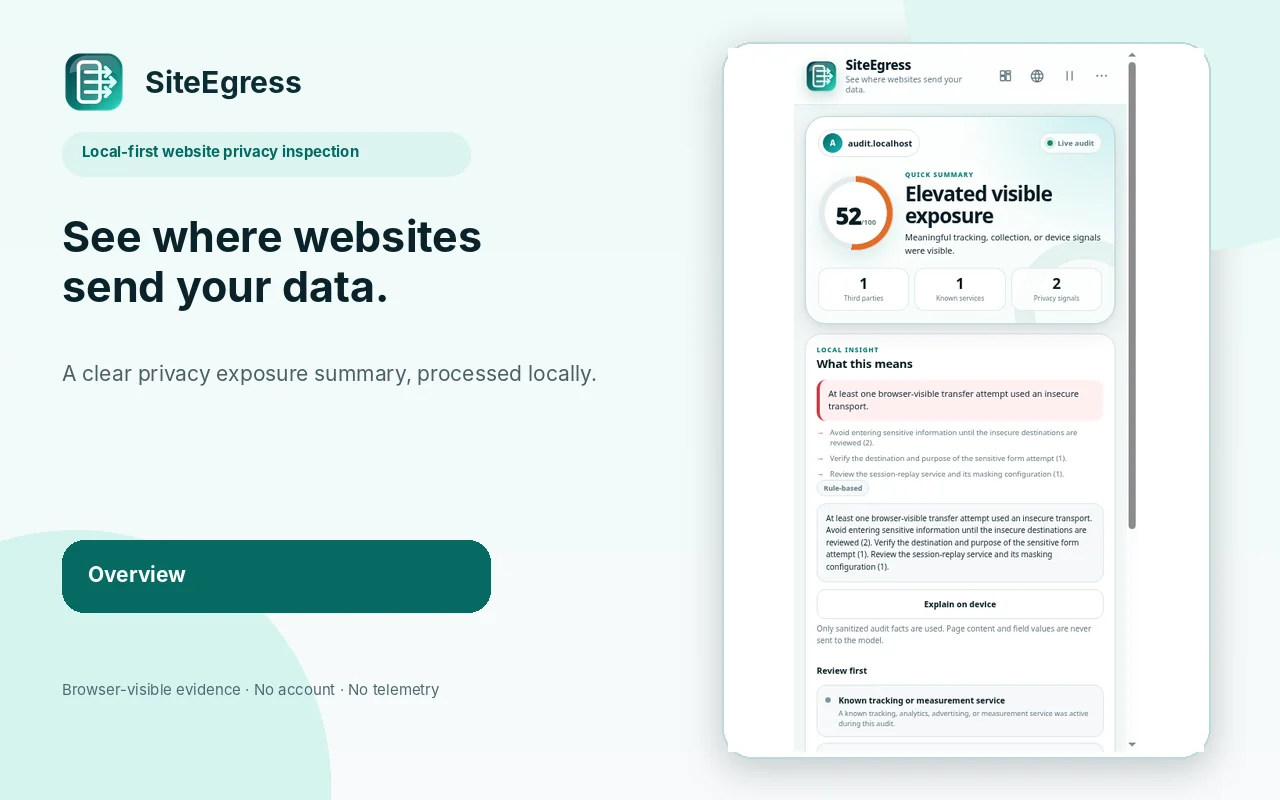
The Side Panel presents a quick summary, full destination map, signals, evidence, optional local history, and exports.
Privacy architecture
Local-first by design
SiteEgress has no account, developer audit backend, telemetry, advertising SDK, cloud sync, or external AI service. Privacy Checkpoints are bounded local summaries. Optional Geo Insights is off by default; raw destination IPs are never retained.
Local-first No telemetry Minimal permissions
What SiteEgress cannot prove
- Server-to-server transfers that are not visible inside the browser
- How a recipient uses data after receiving it
- Whether a website has malicious intent
- Legal compliance with GDPR, CCPA, or other laws
- That a low score means a website collects no data
See the data flow. Compare the privacy choice.
Both extensions are available on the Chrome Web Store. Install them independently from their official listings. SiteEgress 1.4.0 · Agent Guard 1.4.0